The great square of Corfu Town nowadays owes its name to the Venetian word spianata, a large open space. That was the requirement of Venetian defensive policy: a great level field, long as a musket-shot trajectory,in front of the Old Fortress. This space was formed into a square in the short years of French rule. It was then that the Read more...
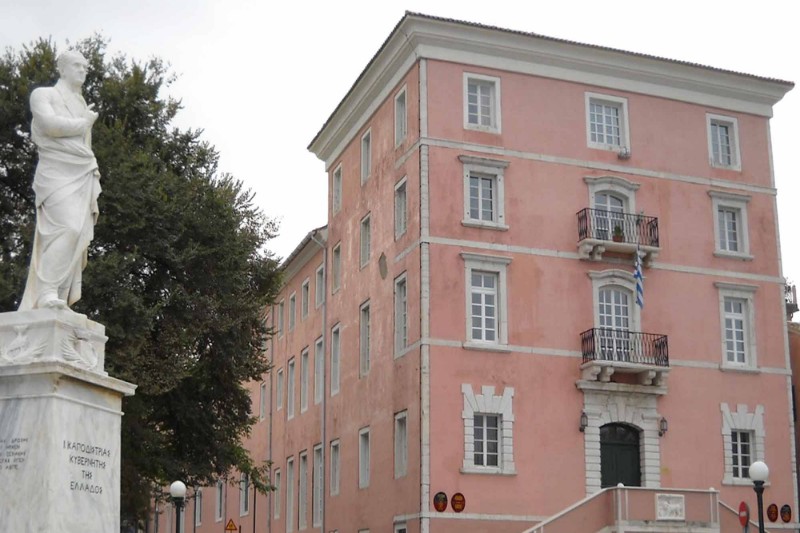
Residential building complex on the Spianada, which was begun under the French empire and forms the main testimony to the French presence on Corfu. The rhythmical repetition of features on the main facade, especially the elegant arcade, reflects the monumental concept of urban design of the Napoleonic period in straight, identical layouts like that of the Rue des Rivoli. The Read more...
This most picturesque little square in town feels like a theatre scene within the densely built Campiello quarter. The cistern at its centre, bearing sculpted stone decorations, was built in 1699 as a donation by a member of the local nobility. The church of Virgin Mary Kremasti and the open space of the square served as a meeting place for Read more...
The main entrance to the New Fortress is a highly monumental structure (columns with Tuscan-Doric elements) by Ferrante Vitelli, a great military architect who drew up the plans for the first fortifications of the town. The main gate is decorated with a relief of the winged Lion of St Mark, the symbol of Venice. Read more...
The Venetian authorities planned and built the New Fortress on St Mark’s Hill, to the north-west of town, on the insistent requests of Corfiots for added defenses against the Ottoman Turks. Construction started in 1576. This fortress and its subordinate bastions (together representing a monumental piece of fortification engineering), combined with the Old Fortress, formed the town’s main line of Read more...
The great building of the Venetian barracks housed the Ionian Academy from 1840 onwards. This building was originally designed to house barracks, in combination with the residence of the Military Commander during the Venetian Rule. This was the first university in modern Greece, founded by Lord Frederick North, Earl of Guilford. It was destroyed by German bombing in 1943. It Read more...
A headland jutting out into the waves, where between its two peaks the medieval town of Corypho developed (hence Corfu today), was to be transformed by engineers of the Venetian Republic into a fortress immune to siege. The impregnable walls of the Old Fortress were initially erected by the Byzantines and later reinforced by the Anjous. But it was the Read more...
This most representative neoclassical structure in Corfu Town was constructed by the British, then in possession of the Ionian islands, and formally presented to the Lord Governor in 1824. The tufa stone for its building was transported from Malta along with a large number of Maltese workers. It was designed by the British architect Whitmore as a residence for the Read more...
The Loggia (today’s San Giacomo) was initially built as a lodge for the assemblies of local nobles.Constructed between 1663 and 1693 with Sinies stone, the only town building with dressed masonry. It was transformed into the lyrical theatre of San Giacomo in 1720. Many operas of the European repertory were produced here, many great artists performed; and many premieres of Read more...
No Records Found
Sorry, no records were found. Please adjust your search criteria and try again.